
Leisure Time E5, Spa 56 Chlorinating Granules for Spas and Hot Tubs, 5 lbs
- Destroys organic contaminants to maintain clean, clear, sanitized water
- Specifically formulated for spa and hot tubs
- Chlorine sanitizing systems
- Quick dissolving, EPA approved formula, helps control algae growth, maintains water clean, clear, and.

EASYTEST 7-Way Pool Test Strips, 150 Strips Water Test for Hot tub and Spa
- This water chemical testing kit contains 150 test strips. Enough balanced for your swimming pool, hot tub.
- Just soak in water for 1 seconds; Then take it out,no need to shake excess water off and hold the test.
- Test all necessary parameters for your swimming pool at 1 time, such as Bromine, Total Alkalinity, pH.
- high quality fiber paper and no-bleeding pads selected after repeated trials by R&D personnel. No need to.

Hot Tub Test Strips for Spas - 6 in 1 Water Test [100 Pack]
- Get more for your money with our pool, spa and hot tub test kit that contains 100 test strips, providing.
- Testing your pool, spa and hot tub water is very quick and easy with our test strips. Simply dip the strip.
- Our pH strips for hot tub and spa water include an eBook packed with important info to help you achieve.
- 1. Keep wet fingers out of the bottle 2. Close the cap tightly between each use 3. Store in a cool, dry.
Standing water in your hot tub with an odd smell, cloudy appearance, or causing skin irritation means the water chemistry is out of balance. Unbalanced water not only makes soaking unpleasant, it can also damage your hot tub's components, leading to costly repairs. Maintaining proper water chemistry is essential for bather safety, equipment longevity, and overall enjoyment.
Why Hot Tub Water Chemistry Matters
Hot tub water is a dynamic environment. Factors like bather load, lotions, soaps, and even airborne debris constantly affect its chemical balance. When chemicals are not balanced, several problems can arise.
- Health Risks: Improper sanitizer levels allow bacteria and algae to thrive, leading to skin rashes, eye irritation, and respiratory issues.
- Equipment Damage: High acidity (low pH) can corrode heaters, pumps, and other metallic parts. High alkalinity or calcium hardness can cause scaling on surfaces and in plumbing, reducing efficiency and lifespan.
- Poor Water Quality: Unbalanced water often appears cloudy, foamy, or develops an unpleasant odor, diminishing the hot tub experience.
Key Hot Tub Water Parameters and Ideal Ranges
To balance chemicals in hot tub water, you need to understand the main parameters. Each plays a role in keeping your water clean and safe. Here are the targets:
- Total Alkalinity (TA): 80-120 ppm (parts per million)
- pH: 7.4-7.6 (acceptable range 7.2-7.8)
- Calcium Hardness (CH): 150-250 ppm
- Sanitizer (Chlorine/Bromine):
- Free Chlorine: 1-3 ppm
- Bromine: 3-5 ppm
Tools and Materials You Will Need
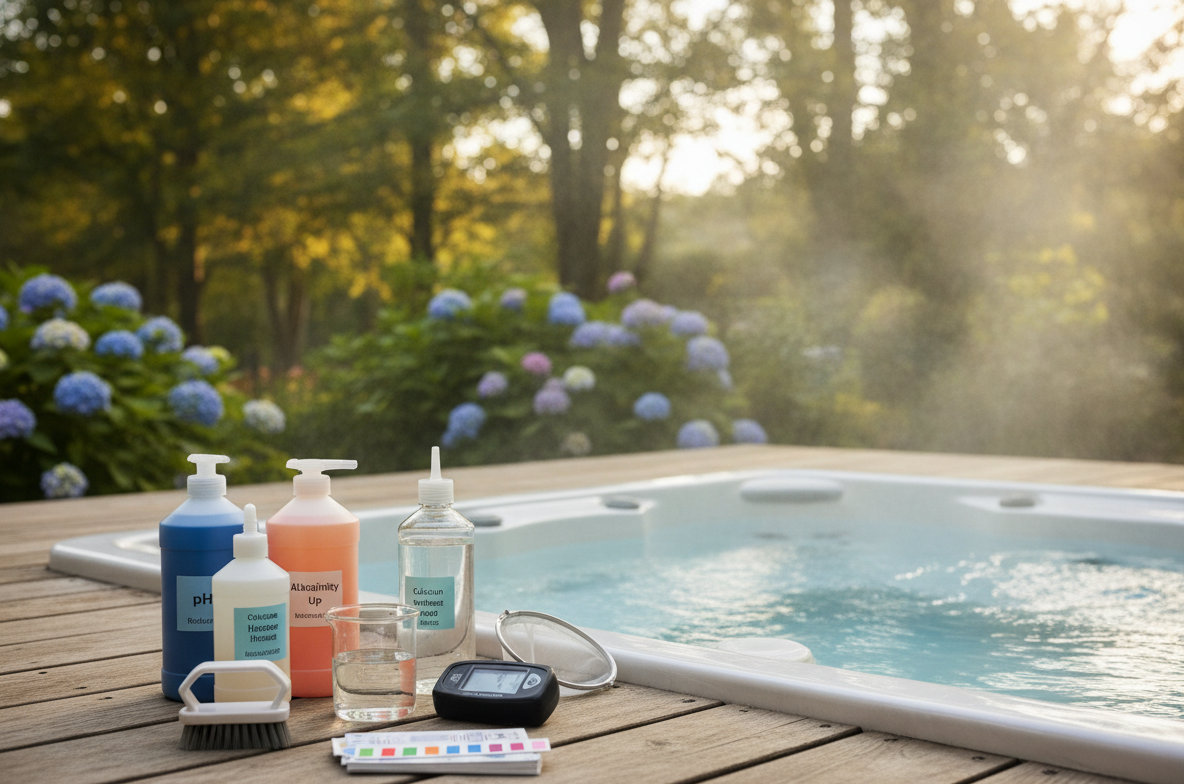
Before you begin balancing your hot tub water, gather these items. Having everything ready makes the process smoother and safer.
- Water Test Strips or Liquid Test Kit: These are essential for accurate readings. Consider options like the EASYTEST 7-Way Pool Test Strips, which provide 150 strips for comprehensive testing of bromine, total alkalinity, and pH. Another reliable choice is the Hot Tub Test Strips for Spas - 6 in 1 Water Test [100 Pack], offering quick results for multiple parameters.
- pH Increaser (Soda Ash) and Decreaser (Dry Acid or Muriatic Acid): These adjust the pH level.
- Alkalinity Increaser (Sodium Bicarbonate): Raises total alkalinity.
- Calcium Hardness Increaser (Calcium Chloride): Raises calcium hardness.
- Sanitizer (Chlorine or Bromine): For chlorine systems, Leisure Time E5, Spa 56 Chlorinating Granules are specifically formulated for spas and hot tubs, destroying organic contaminants to maintain clear, sanitized water.
- Hot Tub Shock Treatment (Non-Chlorine Shock or Dichlor Shock): Oxidizes contaminants.
- Clean Bucket: For pre-mixing chemicals.
- Gloves and Eye Protection: Safety gear is important when handling chemicals.
- Measuring Spoons/Cups: For accurate chemical dosing.
step by step Guide to Balance Hot Tub Water Chemistry
Take your time with each adjustment.
Step 1: Test Your Hot Tub Water
This is the first and most important step. Always test your water before adding any chemicals. Dip a test strip into the water according to the manufacturer's instructions, usually for one second. Remove it without shaking off excess water, then compare the colors on the strip to the color chart provided with your test kit. Note down the readings for total alkalinity, pH, calcium hardness, and your chosen sanitizer.
Step 2: Adjust Total Alkalinity (TA) First
Total alkalinity acts as a buffer, stabilizing your pH level. Adjusting TA before pH helps prevent pH from fluctuating wildly. The ideal range is 80-120 ppm.
- If TA is Low (below 80 ppm): Add an alkalinity increaser (sodium bicarbonate). Add small amounts, usually 1-2 tablespoons per 500 gallons, dissolving it in a bucket of hot tub water before slowly pouring it into the hot tub while the jets are running. Wait at least 20-30 minutes, then re-test. Repeat until the TA is in range.
- If TA is High (above 120 ppm): High TA can be lowered by adding a pH decreaser (dry acid). This will also lower pH, so proceed carefully. Add small amounts, wait, and re-test. Sometimes, aeration (running jets with air blowers on) can help lower TA over time.
Step 3: Adjust pH
Once total alkalinity is within the ideal range, adjust your pH. The target is 7.4-7.6.
- If pH is Low (below 7.2): Add a pH increaser (soda ash). Mix 1-2 tablespoons per 500 gallons in a bucket of hot tub water, then add it slowly to the hot tub with the jets running. Wait 20-30 minutes, then re-test. Repeat as needed. Low pH can cause eye and skin irritation, and also corrode equipment.
- If pH is High (above 7.8): Add a pH decreaser (dry acid). Mix 1-2 tablespoons per 500 gallons in a bucket of hot tub water before adding it slowly to the hot tub. High pH can cause cloudy water, scale formation, and reduced sanitizer effectiveness. For more detailed instructions on lowering pH, you can refer to our guide on How to Lower Pool pH: step by step Guide for Clear Water.
Always make small adjustments and re-test before adding more chemicals. This prevents overshooting your target range.
Step 4: Adjust Calcium Hardness (CH)
Calcium hardness affects how corrosive or scale-forming your water is. The ideal range is 150-250 ppm.
- If CH is Low (below 150 ppm): Add a calcium hardness increaser (calcium chloride). Dissolve the recommended amount (check product label based on your hot tub volume) in a bucket of hot tub water, then slowly pour it into the hot tub. Wait several hours for it to dissolve fully and circulate, then re-test. Low calcium can cause etching on surfaces and corrosion of metal components.
- If CH is High (above 250 ppm): This is harder to correct without draining and refilling with softer water. If your tap water is naturally hard, you may need to use a hose filter when filling your hot tub. High calcium can lead to scale formation on surfaces and inside plumbing.
Step 5: Add Sanitizer (Chlorine or Bromine)
After adjusting TA, pH, and CH, it is time to add your primary sanitizer. This kills bacteria and algae.
- For Chlorine: If you use Leisure Time E5, Spa 56 Chlorinating Granules, add the recommended amount according to the product label (typically 1-2 ounces per 500 gallons for initial dose, then 0.5-1 ounce daily or as needed). Granular chlorine should be broadcast across the water surface or dissolved first in a bucket of water. Maintain a free chlorine level of 1-3 ppm.
- For Bromine: Use bromine tablets in a floating dispenser or feeder. Maintain a bromine level of 3-5 ppm.
Always follow the manufacturer's instructions for your specific sanitizer product. Run your jets for at least 30 minutes after adding sanitizer to ensure good circulation.
Step 6: Shock Your Hot Tub
Shocking your hot tub oxidizes organic contaminants (sweat, oils, lotions) that can build up, reducing sanitizer effectiveness and causing cloudy water or odors. Shocking should be done weekly or after heavy use.
- Use a non-chlorine shock or dichlor shock. Add the recommended amount according to the product label.
- It is best to shock your hot tub in the evening, leaving the cover off for at least 20 minutes to allow gases to escape.
Step 7: Re-Test and Maintain
After all adjustments, wait several hours, or even overnight, then re-test all parameters. Make any minor adjustments needed. Ongoing maintenance is key. Test your hot tub water at least 2-3 times per week, or daily if the hot tub sees heavy use. Regularly check and clean your filter, and drain and refill your hot tub every 3-4 months.
Troubleshooting Common Hot Tub Water Issues
Even with regular balancing, issues can arise. Understanding common problems helps you react quickly.
Cloudy Water
Cloudy water is a frequent complaint. It often indicates low sanitizer levels, high organic load, high calcium hardness, or poor filtration. Check your sanitizer and pH levels first. Shocking the hot tub often helps. Make sure your filter is clean and running correctly. If your water remains cloudy, you might find additional solutions in our article, Hot Tub Cloudy Water Fix: Causes and Clear Water Solutions.
Foaming Water
Foam usually comes from a buildup of soaps, detergents, and body oils. Low calcium hardness can also contribute. Shocking and ensuring proper sanitizer levels can help. There are also anti-foam chemicals available if the problem persists.
Strong Chemical Odor
A strong chlorine smell often means you have too many chloramines (spent chlorine) in the water, not too much active chlorine. This indicates a need to shock the hot tub. A bromine smell can also be strong if levels are high.
Hot Tub Maintenance Schedule
Following a consistent maintenance schedule helps keep your water balanced and prevents problems.
- Daily/Before Each Use: Quick visual check for clarity and debris.
- 2-3 Times Per Week: Test water chemistry (TA, pH, CH, sanitizer). Adjust chemicals as needed.
- Weekly: Clean filter cartridges (rinse thoroughly). Shock the hot tub.
- Monthly: Deep clean filter cartridges using a chemical filter cleaner.
- Every 3-4 Months: Drain, clean, and refill the hot tub with fresh water.
Balancing your hot tub water chemistry is a continuous process. With regular testing and consistent chemical adjustments, you can maintain a clean, clear, and safe hot tub for everyone to enjoy. Pay attention to your water, and it will give you many relaxing soaks.
Leisure Time E5, Spa 56 Chlorinating Granules for Spas and Hot Tubs, 5 lbs
- Destroys organic contaminants to maintain clean, clear, sanitized water
- Specifically formulated for spa and hot tubs
- Chlorine sanitizing systems
- Quick dissolving, EPA approved formula, helps control algae growth, maintains water clean, clear, and.
EASYTEST 7-Way Pool Test Strips, 150 Strips Water Test for Hot tub and Spa
- This water chemical testing kit contains 150 test strips. Enough balanced for your swimming pool, hot tub.
- Just soak in water for 1 seconds; Then take it out,no need to shake excess water off and hold the test.
- Test all necessary parameters for your swimming pool at 1 time, such as Bromine, Total Alkalinity, pH.
- high quality fiber paper and no-bleeding pads selected after repeated trials by R&D personnel. No need to.
Hot Tub Test Strips for Spas - 6 in 1 Water Test [100 Pack]
- Get more for your money with our pool, spa and hot tub test kit that contains 100 test strips, providing.
- Testing your pool, spa and hot tub water is very quick and easy with our test strips. Simply dip the strip.
- Our pH strips for hot tub and spa water include an eBook packed with important info to help you achieve.
- 1. Keep wet fingers out of the bottle 2. Close the cap tightly between each use 3. Store in a cool, dry.