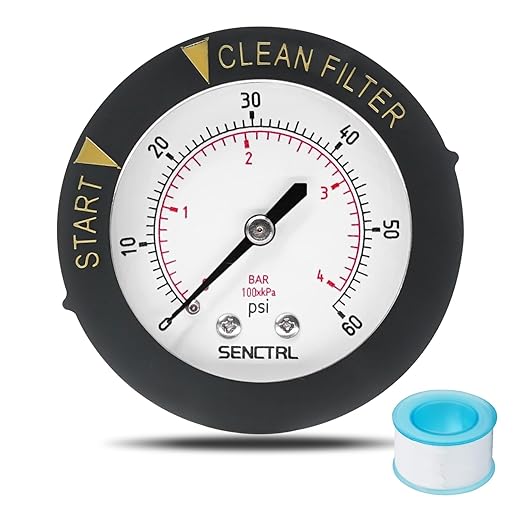
SENCTRL 0-60 Psi Pool Filter Pressure Gauge, 2 inches Dial, 1/4 NPT Back Mount, Stainless Steel Case, Waterproof, Clean Filter
- PRV-Tex Series: The circular dial is encased in a 304 stainless steel casing, providing robustness and.
- Brass and Stainless Steel wetted parts for measuring non-corrosive liquid and gas pressure. Such as water.
- Clean filter indicator: Our pool filter pressure gauge is equipped with a clean filter indicator. It.
- Measures pressure with dual scale (0-60 psi/0-4 bar). Display accuracy is + or - 3/2/3% over the entire.
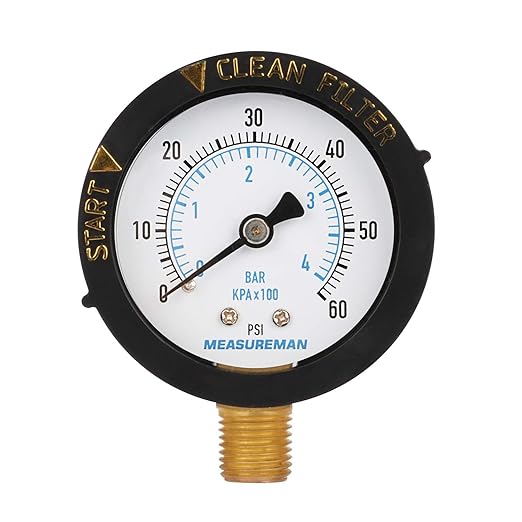
MEASUREMAN 2” Pool Filter Pressure Gauge, 60 PSI, 1/4” NPT Bottom Mount to Pool Pump Pressure Gauge for Swimming Pool, Spa,
- For pressure measuring on the filter of swimming pool,Spa, Aquarium Water etc
- 2" dial size, 1/4"NPT lower mount
- Pressure range: 0-60psi/bar 100xkpa double scale
- Plastic case, twist to move bezel, start and clean filter, brass wetted parts, dry

SENCTRL 0-60 Psi Pool Filter Pressure Gauge, 2 inches Dial, 1/4 NPT Lower Mount, Stainless Steel Case, Waterproof, Clean Filter
- PRV-Tex Series: The circular dial is encased in a 304 stainless steel casing, providing robustness and.
- Brass and Stainless Steel wetted parts for measuring non-corrosive liquid and gas pressure. Such as water.
- Clean filter indicator: Our pool filter pressure gauge is equipped with a clean filter indicator. It.
- Measures pressure with dual scale (0-60 psi/0-4 bar). Display accuracy is + or - 3/2/3% over the entire.
A healthy above ground pool begins with a properly sized and efficient pump. An undersized pump struggles to circulate water, leading to algae growth and chemical imbalances. An oversized pump wastes electricity, driving up utility costs unnecessarily. Understanding the technical specifications and your pool's needs makes choosing the right pump simpler.
Understanding Above Ground Pool Pump Types
Above ground pool pumps generally fall into three categories: single-speed, dual-speed, and variable-speed. Each offers distinct advantages and disadvantages regarding cost, efficiency, and performance.
Single-Speed Pumps
Single-speed pumps operate at one fixed, high speed whenever they are running. They are the least expensive option upfront, typically costing between $150 and $400. Their simplicity means fewer potential points of failure. However, they consume a constant, high amount of electricity. This makes them less energy-efficient over a swimming season, especially if your pool requires many hours of daily filtration.
Dual-Speed Pumps
Dual-speed pumps offer two distinct operating speeds: a high speed for tasks like vacuuming or backwashing and a lower speed for daily filtration. Running the pump at a lower speed for most of the day significantly reduces energy consumption compared to a single-speed model. These pumps usually cost between $300 and $600. They provide a balance between the affordability of single-speed pumps and the efficiency of variable-speed models, making them a good upgrade for many pool owners.
Variable-Speed Pumps
Variable-speed pumps are the most advanced and energy-efficient choice. They allow you to precisely control the motor speed, adjusting it in small increments. This precision means you can run the pump at the lowest possible speed required to keep your pool clean, drastically cutting down on electricity use. While their initial cost is higher, ranging from $500 to $1,200 or more, the energy savings often pay for the pump within one to three seasons. Many utility companies also offer rebates for installing variable-speed pumps, further reducing the effective cost. Variable-speed pumps also run quieter and experience less wear and tear due to lower operating speeds.
Key Specifications to Consider
Several technical specifications dictate a pool pump's performance and suitability for your above ground pool. Paying attention to these numbers prevents costly mistakes.
Horsepower (HP)
Horsepower indicates the pump's motor strength. For most above ground pools, a pump between 0.75 HP and 1.5 HP is sufficient. An oversized pump creates too much pressure, potentially damaging your filter or plumbing. An undersized pump cannot adequately circulate the water, leading to poor filtration and water quality issues.
Flow Rate (GPM or GPH)
The flow rate measures how much water the pump moves per minute (gallons per minute, GPM) or per hour (gallons per hour, GPH). Your pump's flow rate should align with your filter's maximum flow rate and your pool's total volume. The goal is to turn over your entire pool's water volume at least once every 8-10 hours. To calculate your required flow rate, divide your pool's volume in gallons by 8 (for an 8-hour turnover) and then divide by 60 (to get GPM). For example, a 15,000-gallon pool needs a minimum GPM of (15,000 / 8) / 60 = 31.25 GPM.
Total Dynamic Head (TDH)
Total Dynamic Head represents the total resistance the pump must overcome to move water through your plumbing system. This includes friction from pipes, fittings, valves, and the filter itself, as well as any elevation changes. Manufacturers provide flow rate curves that show a pump's GPM at different TDH values. Estimating your pool's TDH is complex, often requiring a professional calculation, but understanding its importance helps you select a pump that performs efficiently under your system's specific conditions.
Voltage
Above ground pool pumps typically operate on 115V or 230V. Most smaller pools use 115V pumps, which plug into standard outdoor outlets. Larger pumps, especially 1.5 HP and higher, often require 230V. This necessitates a dedicated circuit and professional electrical installation. Always check your available electrical supply before purchasing a pump.
Matching Pump to Filter Type
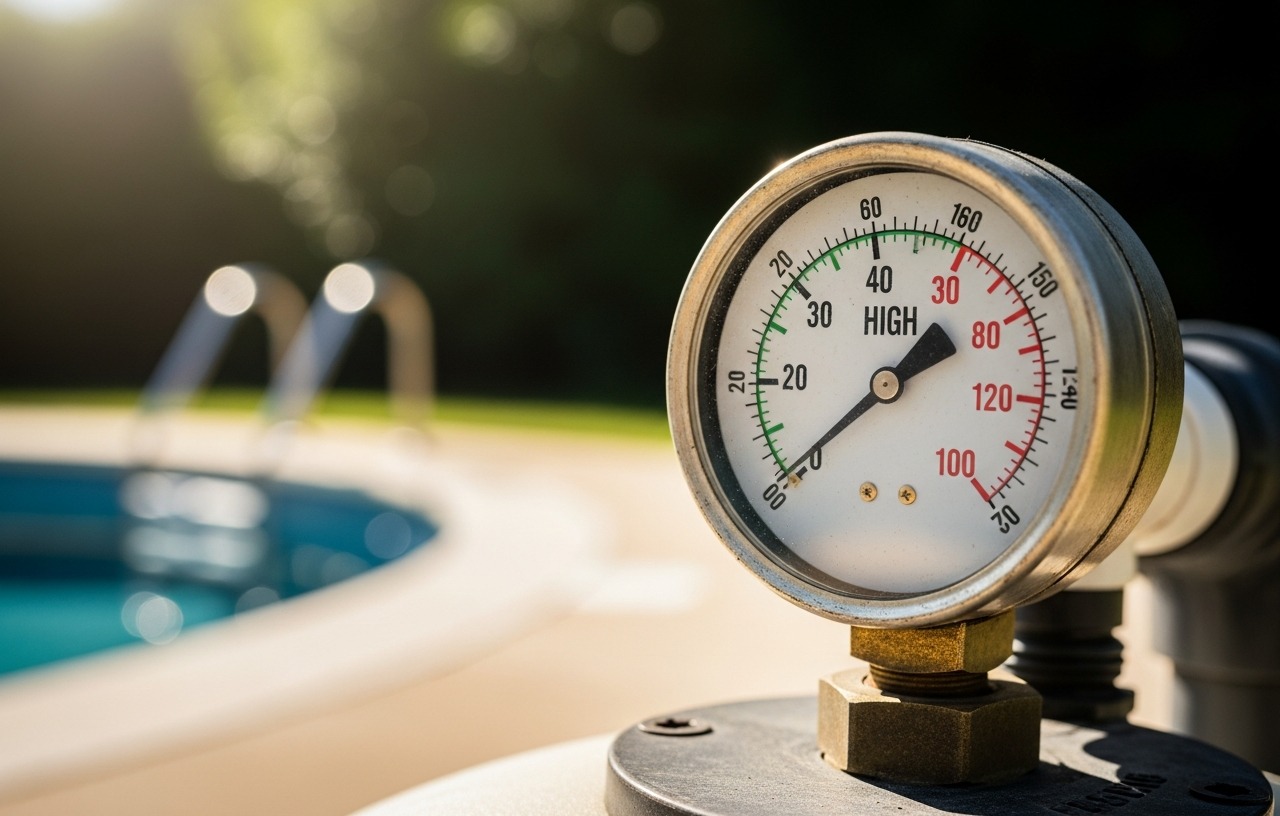
Your filter type significantly influences pump selection. The pump and filter must work together efficiently to maintain clear water. To understand more about filter pressure, you can read our guide on Pool Filter Pressure Too High: Causes & Quick Fixes.
Sand Filters
Sand filters are common for above ground pools due to their affordability and ease of maintenance. They require moderate flow rates and generally tolerate higher pressure than cartridge filters. Make sure your pump's flow rate does not exceed the sand filter's maximum GPM rating, or you risk pushing dirt straight through the sand bed.
Cartridge Filters
Cartridge filters offer excellent filtration and are easy to clean by rinsing the cartridges. They are more sensitive to high flow rates and pressure than sand filters. An overly powerful pump can damage the cartridge elements, reducing their lifespan and filtration effectiveness. Match your pump's GPM to the cartridge filter's specified maximum flow rate.
DE Filters
Diatomaceous Earth (DE) filters offer the finest filtration, providing sparkling clear water. They require specific flow rates and careful backwashing procedures. While less common for basic above ground pools due to their higher cost and maintenance, if you have a DE filter, choose a pump that respects its maximum flow rate and pressure limits.
Installation and Plumbing Considerations
Correct installation ensures optimal pump performance and longevity. Most above ground pool pumps use 1.5-inch or 2-inch plumbing connections. Make sure the pump's intake and discharge ports match your existing plumbing, or plan for adapters. The pump should be installed as close to the pool as possible, below water level if feasible, to improve priming and reduce strain. For a detailed setup guide, refer to How to Set Up an Above Ground Pool Pump Correctly.
Consider the total length and number of bends in your plumbing lines. Longer runs and more elbows increase friction loss, adding to the Total Dynamic Head the pump must overcome. Keeping plumbing runs short and straight improves efficiency.
Red Flags and What to Avoid
- Buying the cheapest option: A very low-cost pump often means lower quality components and higher energy consumption. It can lead to premature failure and greater long term expenses.
- Oversizing the pump: A pump that is too powerful for your pool and filter system wastes electricity and may damage equipment.
- Ignoring noise levels: Some pumps are significantly louder than others. Look for models with good noise ratings, especially if your pool is near a patio or sleeping areas.
- Poor warranty: A short or limited warranty suggests the manufacturer lacks confidence in their product. Look for pumps with at least a 1-year warranty, preferably longer.
- Lack of replacement parts: Choose a brand known for readily available replacement parts, such as impellers, seals, and baskets.
long term Cost of Ownership and Maintenance
The initial purchase price is only part of the equation. Consider the ongoing electricity costs, maintenance, and potential replacement parts. A variable-speed pump, despite its higher upfront cost, can save hundreds of dollars in electricity each year. For example, upgrading from a 1 HP single-speed pump to a variable-speed model could save $200-$500 annually, depending on local electricity rates and run times.
Regular maintenance extends your pump's life. Keep the pump basket clean, inspect seals for leaks, and monitor your filter pressure. A pool filter pressure gauge is an inexpensive yet essential tool for this. The SENCTRL 0-60 Psi Pool Filter Pressure Gauge (PRV-Tex Series) is a robust option. Its circular dial is encased in 304 stainless steel, providing durability. It uses brass and stainless steel wetted parts for measuring non-corrosive liquid and gas pressure, like water. A clean filter indicator helps you know when it is time to backwash or clean your filter, preventing high pressure that strains your pump.
Another reliable choice is the MEASUREMAN 2” Pool Filter Pressure Gauge. This 60 PSI, 1/4” NPT bottom mount gauge is suitable for pressure measuring on swimming pool filters, spas, and aquariums. Its 2-inch dial size makes it easy to read. Similarly, the SENCTRL 0-60 Psi Pool Filter Pressure Gauge, 2 inches Dial, 1/4 NPT Lower Mount, also from the PRV-Tex Series, offers similar features. It has a stainless steel case and a clean filter indicator. Both SENCTRL models provide clear readings and durability, making them excellent tools for proactive pool maintenance.
Expect to replace certain pump components over time. A new pump seal might cost $10-$30, while an impeller could be $30-$80. The average lifespan of a well maintained above ground pool pump is 5-10 years. Professional installation, if needed, can add $100-$300 to the initial cost, but it ensures proper setup and avoids electrical issues.
Comparing Options and Making a Recommendation
Start by determining your pool's exact volume and filter type. Calculate the minimum required GPM for an 8-10 hour turnover. Then, research pumps that meet these basic requirements.
Read customer reviews and check energy efficiency ratings. Look for Energy Star certified models, especially for variable-speed pumps, as these guarantee significant energy savings. Compare warranties and the availability of replacement parts.
Our Top Recommendation
For most above ground pool owners, a variable-speed pump offers the best long term value. While the upfront cost is higher (typically $500-$1,200), the energy savings quickly offset this. They also run quieter, experience less wear and tear, and provide greater control over your pool's filtration schedule. This results in cleaner water and lower operating costs over the life of the pump. Many utility companies offer rebates for these energy-efficient models, further sweetening the deal.
If budget constraints are very tight, a dual-speed pump (around $300-$600) is a good compromise, providing better efficiency than a single-speed pump without the full investment of a variable-speed model. Only consider a single-speed pump (under $400) for very small, infrequently used pools, or if your budget absolutely prohibits other options, and you understand the higher operating costs involved.
Choosing the right above ground pool pump is an investment in your pool's health and your wallet. By understanding your pool's needs and the available pump technologies, you can select a pump that provides years of efficient, trouble-free operation.
SENCTRL 0-60 Psi Pool Filter Pressure Gauge, 2 inches Dial, 1/4 NPT Back Mount, Stainless Steel Case, Waterproof, Clean Filter
- PRV-Tex Series: The circular dial is encased in a 304 stainless steel casing, providing robustness and.
- Brass and Stainless Steel wetted parts for measuring non-corrosive liquid and gas pressure. Such as water.
- Clean filter indicator: Our pool filter pressure gauge is equipped with a clean filter indicator. It.
- Measures pressure with dual scale (0-60 psi/0-4 bar). Display accuracy is + or - 3/2/3% over the entire.
MEASUREMAN 2” Pool Filter Pressure Gauge, 60 PSI, 1/4” NPT Bottom Mount to Pool Pump Pressure Gauge for Swimming Pool, Spa,
- For pressure measuring on the filter of swimming pool,Spa, Aquarium Water etc
- 2" dial size, 1/4"NPT lower mount
- Pressure range: 0-60psi/bar 100xkpa double scale
- Plastic case, twist to move bezel, start and clean filter, brass wetted parts, dry
SENCTRL 0-60 Psi Pool Filter Pressure Gauge, 2 inches Dial, 1/4 NPT Lower Mount, Stainless Steel Case, Waterproof, Clean Filter
- PRV-Tex Series: The circular dial is encased in a 304 stainless steel casing, providing robustness and.
- Brass and Stainless Steel wetted parts for measuring non-corrosive liquid and gas pressure. Such as water.
- Clean filter indicator: Our pool filter pressure gauge is equipped with a clean filter indicator. It.
- Measures pressure with dual scale (0-60 psi/0-4 bar). Display accuracy is + or - 3/2/3% over the entire.