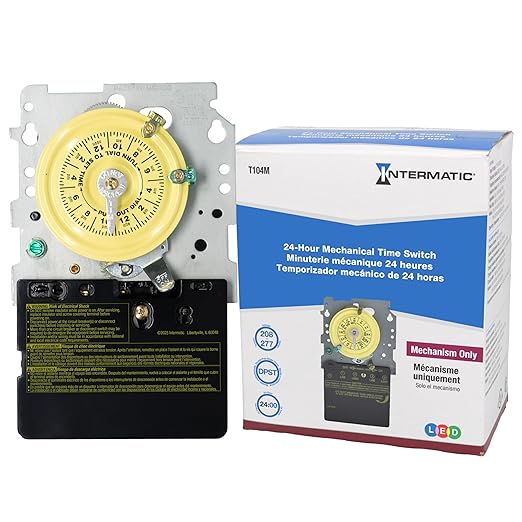
Intermatic T104M Mechanical Time Switch Mechanism Only
- The Intermatic T100 Series Mechanical Time Switch has a proven track record of durability, standing the.
- With the highest HP ratings in the industry, this time switch can handle electrical loads up to 40 A per.
- Enjoy direct 24-hour control with the flexibility of up to 12 ON/OFF operations per day. Set minimum.
- The built-in manual override switch adds convenience, allowing you to take immediate control when needed.

DEWENWILS Pool Pump Timer, Digital Timer Box, 2HP 40A 120-277 VAC, 7-Day 20 ON/Off Programmable Timer Switch for Water Heater,
- [Multiple Setting & 5 Modes] Up to 20 ON/OFF schedules for 7-day repeat cycles or a single-day setting to.
- [Heavy Duty 40 AMP & Versatile] With 40 Amp 2HP 120/240/277 VAC, the pool pump timer control up to 2 units.
- [Built-in Battery Keeps Settings] Backup battery included with 3 months available; No need to repeat.
- [Weather-resistant & Durable] Waterproof resin PC housing with flame-retardant insulation resists UV &.

T104M Pool Timer Mechanism Only, Pool Pump Timer, 208-277V 40A Time Switch, 24 Hour 12 ON/Off for Pool Pump, heavy duty
- Our T104M pool timer comes with a 5-year warranty. We at Bxmgr support the service of replacing the timer.
- The T104M pool timer is suitable for 240V (208-277VAC) systems and can handle electrical loads up to 40A.
- The T104M heavy machinery timer switch dashboard offers clear 24-hour scales with 15-minute interval.
- EASY TO INSTALL:T104M pool pump timer comes with a detailed installation manual. The terminal interface.
Silence from your pool pump can quickly turn your swimming oasis into a stagnant pond. When your pool pump is not running, the problem usually stems from one of three main areas: electrical power, the time switch controlling its operation, or the pump motor itself. Diagnosing the issue early can save you from costly technician visits and ensure your pool stays clean.
This guide walks you through common scenarios, from a completely dead pump to one that is humming but not running, providing step by step checks and estimated repair costs for 2026. You can identify the specific problem and decide whether a DIY fix is possible or if professional help is needed.
Electrical Problems: No Power to the Pump
The most frequent reason a pool pump is not running involves its power supply. Before checking anything else, make sure the pump is receiving electricity.
Check the Circuit Breaker
A tripped circuit breaker is a common culprit. Pool pumps draw significant power, and a sudden surge or overload can cause the breaker to trip, cutting power to the pump. This is especially true for older electrical panels or during heavy electrical use in your home.
- Locate Your Breaker Panel: Find the electrical panel that controls your pool equipment. It is usually a gray metal box, often located near the pool equipment or in your garage.
- Identify the Pump Breaker: Look for a breaker labeled for the pool pump. If not labeled, it will likely be a 20-amp or 30-amp double-pole breaker (two switches connected by a bar).
- Reset the Breaker: If the breaker is in the 'off' position, or halfway between 'on' and 'off', push it firmly to the 'off' position first, then back to 'on'.
If the breaker immediately trips again, there is a short circuit or an overload somewhere in the pump's electrical line or motor. Do not keep resetting it, as this can cause damage. The cost to replace a standard 20-30 amp circuit breaker is about $15 to $30 for the part. An electrician typically charges $100 to $250 for a service call to diagnose and replace a breaker, plus labor.
Test the GFCI Outlet
Many pool pumps are plugged into Ground Fault Circuit Interrupter (GFCI) outlets for safety. These outlets protect against electrical shock by tripping when they detect a current imbalance. A GFCI outlet can trip independently of the main circuit breaker.
- Locate the GFCI Outlet: If your pump plugs into an outlet, it will likely have 'test' and 'reset' buttons.
- Press 'Reset': Push the 'reset' button firmly. You might hear a click.
- Check the Pump: See if the pump starts running.
If the GFCI immediately trips again, there could be a fault in the pump motor or its wiring. A GFCI outlet costs $15 to $30. An electrician's visit to diagnose and replace a faulty GFCI typically costs $100 to $250.
Inspect Wiring and Connections
Loose or corroded wiring can prevent power from reaching the pump. Always turn off the circuit breaker before inspecting any wiring.
- Pump Connection Box: Carefully open the wiring compartment on the pump motor. Look for any burnt wires, loose connections, or signs of corrosion.
- Timer Box Connections: If your pump uses an external timer, check the wiring inside the timer box.
This inspection often requires electrical knowledge. If you are not comfortable with electrical work, contact a licensed electrician. Repairing loose wiring might cost $75 to $150, while extensive rewiring could be $200 to $500 or more, depending on the damage.
Time Switch Issues: Pool Pump Timer Not Working
If your pool pump is not running according to its schedule, or not running at all, the time switch is a prime suspect. A faulty pool pump timer can prevent power from reaching the motor even if the electrical supply is fine.
Check Manual Override and Settings
Many pool pump timers have a manual override switch or dial. This allows you to bypass the programmed schedule and turn the pump on or off directly.
- Locate Manual Override: On mechanical timers, this is often a small lever or a knob you can turn. On digital timers, look for a 'manual' or 'on/off' button.
- Attempt Manual Start: Try to manually turn the pump on. If the pump starts when manually overridden, the problem is with the timer's programming or its internal mechanism.
- Verify Programmed Schedule: Double-check the timer's settings. Ensure the 'on' pins or digital schedules are set correctly for the current time and day. Sometimes, a power outage can reset digital timers, or mechanical pins can become loose.
Consider Timer Replacement
If the pump runs manually but not on its programmed schedule, or if the timer itself is unresponsive, it likely needs replacement. This is a common issue for older pool systems, including those using an Intex pool pump.
For mechanical timers, the internal gears can wear out or seize. Digital timers can suffer from internal component failure or battery depletion, which causes them to lose settings. Replacing a pool pump timer is a common DIY task for those comfortable with basic electrical work, provided the power is completely shut off at the breaker first.
Recommended Pool Pump Timers for 2026
-
[TOP PICK] Intermatic T104M Mechanical Time Switch Mechanism Only: The Intermatic T100 Series Mechanical Time Switch has a proven track record of durability, standing the test of time. With the highest HP ratings in the industry, this time switch can handle electrical loads up to 40 A per pole. Enjoy direct 24-hour control with the flexibility of up to 12 ON/OFF operations per day. Set minimum ON/OFF times of 1 hour.
-
[Option 2] DEWENWILS Pool Pump Timer, Digital Timer Box, 2HP 40A 120-277 VAC: This digital timer offers multiple settings and 5 modes, with up to 20 ON/OFF schedules for 7-day repeat cycles or a single-day setting. It is heavy duty with 40 Amp 2HP 120/240/277 VAC, controlling up to 2 units. A built-in battery keeps settings for up to 3 months, eliminating the need to repeat programming after power outages.
-
[Option 3] T104M Pool Timer Mechanism Only, 208-277V 40A Time Switch: This T104M pool timer comes with a 5-year warranty. It is suitable for 240V (208-277VAC) systems and can handle electrical loads up to 40A. The heavy machinery timer switch dashboard offers clear 24-hour scales with 15-minute intervals.
A new timer mechanism or digital timer box typically costs $50 to $150. If you hire an electrician for replacement, expect an additional $100 to $250 in labor costs.
Motor Problems: Pool Pump Humming But Not Running
If you hear a humming sound coming from the pump but it is not running, the motor is receiving power but cannot spin. This often points to a seized impeller, a faulty capacitor, or an issue with the motor windings.
Check for a Seized Impeller
The impeller is a rotating component inside the pump that moves water. Debris like leaves, hair, or small stones can get lodged in the impeller, preventing it from turning. This is a common cause for an Intex pool pump not running or any other brand.
- Disconnect Power: Turn off the circuit breaker to the pump.
- Access the Impeller: Remove the pump's volute (the front housing) or drain plug to access the impeller chamber. You might need a wrench to remove bolts.
- Clear Debris: Visually inspect the impeller. Use a small screwdriver or a pair of needle-nose pliers to carefully remove any debris. Spin the impeller by hand to make sure it moves freely.
Clearing a seized impeller costs nothing if you do it yourself. If the impeller itself is damaged, a replacement impeller can cost $30 to $100, plus labor if a professional performs the repair.
Test the Starting Capacitor
Many pool pump motors use a starting capacitor to give them an initial jolt of electricity to begin spinning. If this capacitor fails, the motor will hum but not start.
- Disconnect Power: Turn off the circuit breaker to the pump.
- Locate the Capacitor: The capacitor is usually a cylindrical component located on top or side of the motor, often covered by a protective cap.
- Discharge the Capacitor: Capacitors can store a dangerous electrical charge. Use an insulated screwdriver to short the terminals together, making sure to avoid touching the metal shaft.
- Inspect for Swelling: A bulging or leaking capacitor is a clear sign of failure.
- Test with a Multimeter: If you have a multimeter with a capacitance setting, you can test the capacitor for proper microfarad (µF) readings.
"A failing starting capacitor is a very common reason for a pool pump humming but not working. The motor tries to start, but lacks the necessary surge of power to overcome inertia."
Replacing a starting capacitor is a relatively inexpensive repair, costing $15 to $50 for the part. If a professional replaces it, expect to pay $75 to $150 in labor.
Inspect Motor Windings
Burnt or damaged motor windings can cause a pump to hum and eventually fail. This is a more serious problem.
- Disconnect Power: Turn off the circuit breaker.
- Remove Motor Cover: Carefully remove the rear cover of the motor to expose the windings.
- Look for Damage: Inspect for any signs of burning, charring, or melted insulation on the copper windings.
If the motor windings are burnt, the motor itself is typically beyond economical repair and needs replacement. A new pool pump motor costs $200 to $600, while a complete new pump assembly (motor and wet end) can range from $400 to $1,200, depending on horsepower and brand. Professional installation of a new motor or pump can add $250 to $500.
Other Potential Issues
While less common for a completely non-running pump, these issues can contribute to pump problems:
- Low Water Level: If the pool water level is too low, the pump might struggle to prime, leading to air in the system. While not directly causing a 'not running' issue, it can lead to overheating and pump shutdown. Make sure your water level is always halfway up the skimmer opening. For more on this, see our guide on Pool Pump Not Priming? Here's How to Fix It.
- Skimmer Basket or Pump Basket Clog: A severely clogged skimmer or pump basket can restrict water flow, causing the pump to run dry and overheat. This usually results in the pump shutting down. Regularly check and empty these baskets. Learn more about What is a Pool Skimmer Basket?.
When to Call a Professional
If you have tried these troubleshooting steps and your pool pump is still not running, or if you are uncomfortable performing electrical checks, it is time to call a qualified pool technician or licensed electrician. A professional can quickly diagnose complex electrical issues, motor problems, or internal component failures that are difficult for a DIYer to pinpoint.
A typical service call fee for a pool technician ranges from $75 to $150. This fee usually covers the diagnosis. Any subsequent repairs, parts, and labor will be additional. Consider these simple practices:
- Clean Baskets Regularly: Empty the skimmer and pump strainer baskets at least once a week, or more often if you have heavy debris.
- Maintain Water Level: Make sure your pool's water level is always at the midpoint of your skimmer opening to prevent the pump from running dry.
- Inspect Wiring: Periodically check visible wiring for signs of wear, corrosion, or critter damage.
- Monitor for Noise: Listen for unusual noises or changes in the pump's operation, such as grinding or excessive humming.
- Service Timers: If using a mechanical timer, make sure the pins are securely in place. For digital timers, check the backup battery periodically.
By staying proactive, you can keep your pool pump running efficiently and enjoy a clear, well-circulated pool all season long.
Intermatic T104M Mechanical Time Switch Mechanism Only
- The Intermatic T100 Series Mechanical Time Switch has a proven track record of durability, standing the.
- With the highest HP ratings in the industry, this time switch can handle electrical loads up to 40 A per.
- Enjoy direct 24-hour control with the flexibility of up to 12 ON/OFF operations per day. Set minimum.
- The built-in manual override switch adds convenience, allowing you to take immediate control when needed.
DEWENWILS Pool Pump Timer, Digital Timer Box, 2HP 40A 120-277 VAC, 7-Day 20 ON/Off Programmable Timer Switch for Water Heater,
- [Multiple Setting & 5 Modes] Up to 20 ON/OFF schedules for 7-day repeat cycles or a single-day setting to.
- [Heavy Duty 40 AMP & Versatile] With 40 Amp 2HP 120/240/277 VAC, the pool pump timer control up to 2 units.
- [Built-in Battery Keeps Settings] Backup battery included with 3 months available; No need to repeat.
- [Weather-resistant & Durable] Waterproof resin PC housing with flame-retardant insulation resists UV &.
T104M Pool Timer Mechanism Only, Pool Pump Timer, 208-277V 40A Time Switch, 24 Hour 12 ON/Off for Pool Pump, heavy duty
- Our T104M pool timer comes with a 5-year warranty. We at Bxmgr support the service of replacing the timer.
- The T104M pool timer is suitable for 240V (208-277VAC) systems and can handle electrical loads up to 40A.
- The T104M heavy machinery timer switch dashboard offers clear 24-hour scales with 15-minute interval.
- EASY TO INSTALL:T104M pool pump timer comes with a detailed installation manual. The terminal interface.